Target-Dependent Variability in Near Point of Convergence Measurements: A Repeated-Measures Study
Doi: 10.36351/pjo.v42i3.2409
DOI:
https://doi.org/10.36351/pjo.v42i3.2409Abstract
Purpose: To determine the test difference between the Near Point of Convergence (NPC) break and recovery distance depending upon accommodative fixation target and non-accommodative fixation target and the degree of difference that could be ascribed to the measurement method in healthy young adults that have normal binocular vision.
Study Design: A Repeated-Measures Study.
Place and Duration of Study: Teerthanker Mahaveer University, India from January 2025 to December 2025.
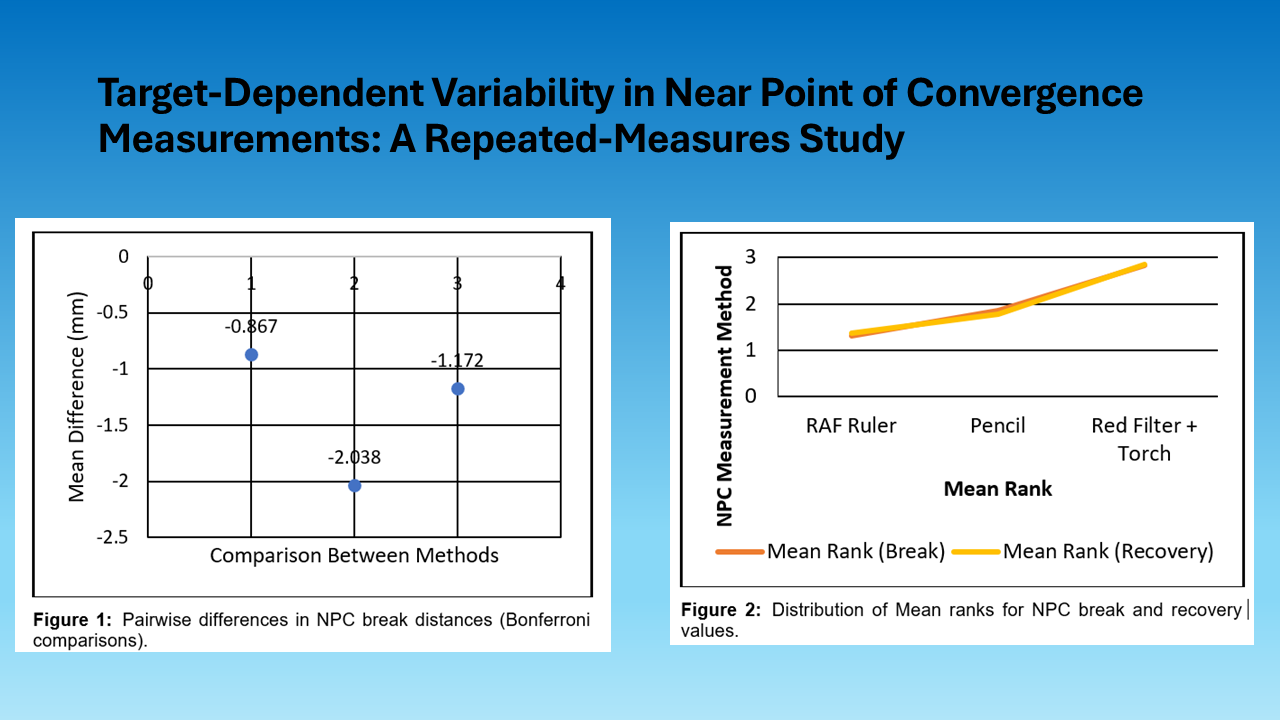
Methods: The study involved 130 subjects (20-26 years of age) with normal vision. RAF ruler and pencil scale push up(accommodative target) and NPC with red-filter torchlight (non-accommodative target)methodswere used for NPC break and recovery. Measurements were taken under ordinary conditions by one examiner. Descriptive statistics, ANOVA and Bonferonni adjusted post-hoc analysis were used.
Results: The three methods were found to be statistically significant in the NPC break and recovery distances (p < 0.001). The accommodation targets were much closer to NPC than the non-accommodative. The RAF ruler provided the least distance of break and recovery and was followed by the pencil push-up method and then finally, the NPC with red-filter torch-light method provided the most receded values. The size of the effect was significant that indicated that the level of influence of target type on NPC outcomes was high.
Conclusion: Accommodative and non-accommodative NPC are exhaustive of each other and NPC is a clinic-dependent strategy. NPC assessment techniques should also be used and reported consistently to achieve proper clinical interpretation and comparability of the results in research.
Downloads
Published
How to Cite
Issue
Section
License
Copyright (c) 2026 Mr. Shamit Pal, Dr. Priye Suman Rastogi

This work is licensed under a Creative Commons Attribution-NonCommercial 4.0 International License.