Accuracy of Refractive Outcomes in Pediatric Cataract Surgery: A Comparison of Targeted Versus Achieved Hyperopia
Doi: 10.36351/pjo.v42i1.2267
DOI:
https://doi.org/10.36351/pjo.v42i1.2267Abstract
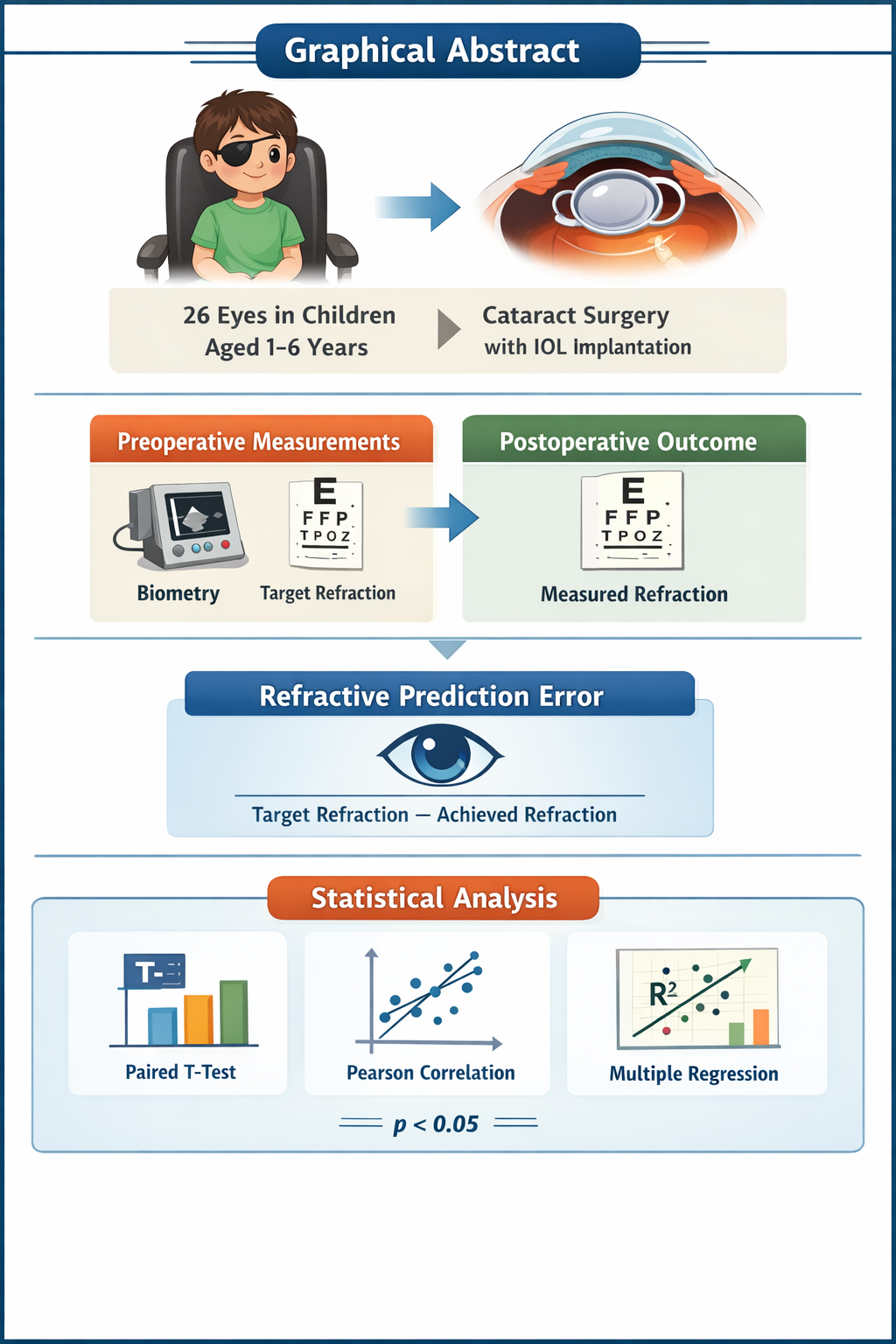
Purpose: To compare target hyperopic refraction with achieved postoperative refractive outcomes in pediatric cataract surgery and to identify factors influencing absolute prediction error.
Study Design: longitudinal cohort study.
Place and Duration of Study: Mughal Eye Hospital, July 2024 to December 2024.
Methods: This study included 26 eyes of children aged 1–6 years undergoing cataract surgery with intraocular lens implantation. Preoperative biometric parameters and target refraction were recorded, and postoperative achieved refraction was measured. Statistical analysis included paired t-test, Pearson correlation, and multiple linear regression to evaluate refractive prediction error (p < 0.05).
Results: The mean age of the patients was 3.69 ± 1.81 years. Mean axial length was 22.56 ± 1.78 mm, and mean IOL power was 23.33 ± 5.94 D. The mean achieved postoperative refraction was 4.47 ± 1.46 D compared to target refraction of 3.76 ± 1.11 D, resulting in a mean hyperopic prediction error of +0.71 D (95% CI: 0.55–0.86; p < 0.001). Absolute prediction error was negatively correlated with age (r = −0.987, p = 0.001) and axial length (r = −0.956,
p = 0.001), and positively correlated with keratometry (r = 0.986, p = 0.001) and IOL power (r = 0.982, p = 0.001).
Conclusion: A consistent hyperopic overshoot relative to target refraction was observed after pediatric cataract surgery. Age and axial length were the most significant contributors to refractive prediction error, highlighting the need for individualized IOL calculations in younger children with shorter axial lengths.
Downloads
Published
How to Cite
Issue
Section
License
Copyright (c) 2025 Amna Mehmud, Seema Qayyum, Fiza Azhar, Noor ul Ain, Hira Awais

This work is licensed under a Creative Commons Attribution-NonCommercial 4.0 International License.