Evaluating the Effect of Surgical Face Mask on Choroidal Thickness
Doi: 10.36351/pjo.v42i1.2204
DOI:
https://doi.org/10.36351/pjo.v42i1.2204Abstract
Purpose: To evaluate the choroidal thickness in healthcare professionals using a surgical face mask.
Study Design: Cross sectional study.
Place and Duration of Study: Ittefaq Hospital, Lahore, and Sohail’s Oculab from June 2023 to July 2024.
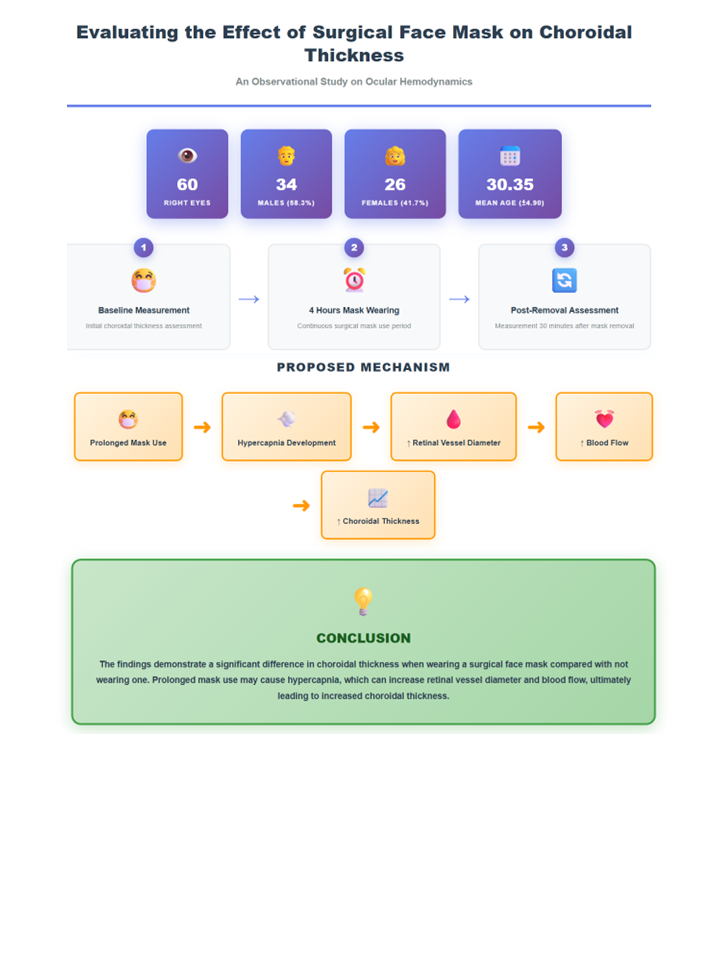
Method: Sixty healthcare professionals aged 25–45 years with best corrected visual acuity of 6/6 or 6/9 and normal intraocular pressure (12–21 mmHg) were included. Participants with any systemic or ocular pathology were excluded. The instruments used in this study included a distance Snellen chart, an air-puff tonometer (Topcon), and a swept-source OCT device (Topcon DRI OCT Triton 3D). A self-structured proforma was used for data collection. Choroidal thickness was measured after wearing a surgical face mask for at least 4 hours and again 30 minutes after mask removal using swept-source OCT.
Results: The study included the right eyes of 60 participants in which there were 34 males (58.3%) and 26 females (41.7%). The mean age was 30.35 ± 4.90 years. A paired-sample t-test showed a statistically significant change in choroidal thickness between 4 hours of mask wearing and 30 minutes after mask removal (p < 0.001).
Conclusion: The findings showed a significant difference in choroidal thickness when wearing a surgical face mask compared with not wearing one. Prolonged mask use may cause hypercapnia, which can increase retinal vessel diameter and blood flow, leading to increased choroidal thickness.
Downloads
Published
How to Cite
Issue
Section
License
Copyright (c) 2025 Rida e Noor Gill, Sadia Saddiqi, Athar Habib, Mawra Zahid

This work is licensed under a Creative Commons Attribution-NonCommercial 4.0 International License.