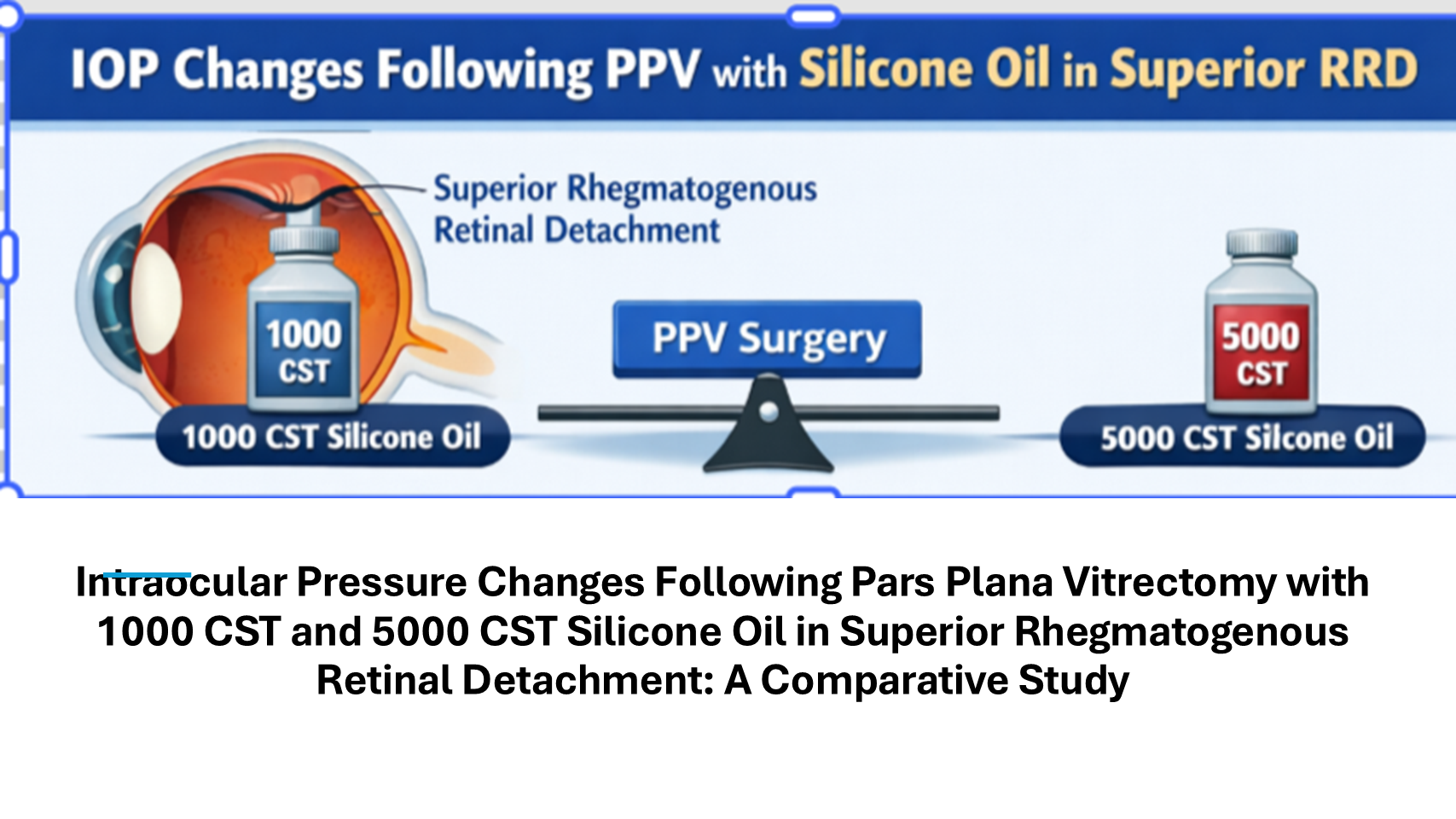
Intraocular Pressure Changes Following Pars Plana Vitrectomy with 1000 CST and 5000 CST Silicone Oil in Superior Rhegmatogenous Retinal Detachment: A Comparative Study
Doi: 10.36351/pjo.v42i1.2105
DOI:
https://doi.org/10.36351/pjo.v42i1.2105Abstract
Purpose: To compare mean IOP changes following PPV using 1000 CST and 5000 CST silicone oil in patients with superior Rhegmatogenous Retinal Detachment (RRD).
Study Design: Quasi experimental study.
Place and Duration of Study: Layton Rahmatullah Benevolent Trust (LRBT) from January 2024 to June 2024.
Methods: A total of 150 patients with age range of 21 to 70 years, diagnosed with superior rhegmatogenous retinal detachment (RRD) and proliferative vitreoretinopathy (PVR) of grade B or C, were recruited. They were divided into two groups; Group A underwent vitrectomy with 1000 centistokes (cSt) and Group B had 5000 cSt silicone oil as tamponade. Intraocular pressure (IOP) was measured before and at 6, 12, 24, and 48 hours after surgery. Independent sample t-test was used to compare the results with p-value of ≤0.05 as significant.
Results: The mean age was comparable between the two groups (Group A: 44.64 ± 14.71 years; Group B: 44.76 ± 14.09 years). A postoperative increase in IOP was observed in both groups. However, at 24 and 48 hours, Group B demonstrated significantly higher IOP compared to Group A, with mean values of 19.34 ± 0.86 vs. 18.64 ± 0.61 mmHg (p = 0.001) and 19.70 ± 1.09 vs. 19.22 ± 0.92 mmHg (p = 0.004), respectively.
Conclusion: Both 1000 cSt and 5000 cSt silicone oil lead to IOP elevation after PPV, but the increase is more significant and sustained in the 5000 cSt group. Careful IOP monitoring is recommended, especially in patients receiving high-viscosity silicone oil.
Downloads
Published
How to Cite
Issue
Section
License
Copyright (c) 2025 Muhammad Usama Manzoor, Kashif Iqbal, Fawad ur Rehman, Muhammad Manzoor, Shazmina Rehman

This work is licensed under a Creative Commons Attribution-NonCommercial 4.0 International License.